.png?width=1774&height=887&name=ChatGPT%20Image%20Aug%203%2c%202026%2c%2001_58_55%20PM%20(2).png)
CMMC Compliance
CUI Scoping
CUI Discovery
.png?width=1774&height=887&name=ChatGPT%20Image%20Aug%203%2c%202026%2c%2001_58_55%20PM%20(1).png)

CUI misclassification is more than a labeling problem. Learn how unidentified, overidentified, or misplaced CUI can affect CMMC scope, compliance costs, incident response, and contract risk.
The citations below support editorial and compliance review. They can be removed from the HubSpot version after the article is approved.
Misclassified Controlled Unclassified Information is often treated as a document-labeling problem. For defense contractors, the larger risk is that CUI may be unmarked, incorrectly marked, copied into an unauthorized location, embedded inside a complex file, or missing from the organization’s documented CMMC boundary.
When that happens, a contractor may make important security, compliance, and purchasing decisions using an incomplete picture of its environment.
The organization may protect systems that do not need to be in scope, overlook systems that do, build an enclave around inaccurate assumptions, or struggle to determine whether CUI was affected during a cyber incident.
Accurate CUI identification is therefore not simply an administrative task. It is a foundational requirement for defensible CMMC scoping, effective risk management, and informed compliance planning.
Controlled Unclassified Information, or CUI, is information that requires safeguarding or dissemination controls under applicable law, regulation, or government-wide policy but is not classified under national security classification authorities. The National Archives and Records Administration maintains the CUI Registry as the government-wide source for authorized CUI categories and related guidance.
CUI can include information within categories such as controlled technical information, export-controlled information, certain privacy information, procurement and acquisition information, and other protected government-related data. Whether a specific document or data element is CUI depends on the governing authority, agency guidance, and applicable contract requirements.
Contractors should not treat every sensitive document as CUI or assume that an unmarked document cannot contain CUI. Industry organizations must follow the requirements contained in their contracts and supporting documentation. Questions about unclear or missing CUI markings should be directed to the information originator, contracting activity, or appropriate government contract contact.
The phrase “CUI misclassification” can describe several different problems.
Information that should be handled as CUI is not recognized as CUI.
The file may be unmarked, stored under an unclear name, embedded in a drawing, included in an email attachment, or copied from an older project folder. Because the organization does not recognize it, the file may remain outside the approved CUI boundary.
Information that is not CUI is treated as though it were.
This can unnecessarily expand the systems, users, applications, and service providers included in the organization’s CMMC scope. The result may be additional licensing, security controls, consulting work, documentation, and assessment effort that do not reduce meaningful risk.
The organization recognizes that information is sensitive but applies the wrong CUI category, handling requirement, or dissemination control.
This can create inconsistent safeguards and confusion among employees, subcontractors, security teams, and compliance personnel.
The organization’s SSP, diagrams, inventories, and internal policies say that CUI exists in one location, while the actual files exist somewhere else.
This is particularly serious because CMMC scoping depends on the systems that process, store, or transmit FCI or CUI. A documented boundary is not defensible when it does not match the organization’s real data environment.
CUI discovery is difficult because contractors rarely operate in clean, centralized environments.
Information may be distributed across:
CUI can also move throughout its lifecycle. A correctly handled file may later be downloaded, forwarded, duplicated, renamed, restored from a backup, or saved into an unauthorized location.
These conditions make several common discovery approaches unreliable when used alone.
Markings are important, but they do not provide a complete inventory. Legacy files may use outdated markings, derivative content may not be marked consistently, and users may remove or overlook required headers and banners.
Employees can explain how they believe information flows, but memory and operational assumptions are not the same as file-level evidence. Staff members may also use different definitions of CUI.
A file name rarely establishes whether its contents are CUI. Broad keyword matching can also produce large numbers of irrelevant results, especially when technical terms appear in ordinary business documents.
A discovery exercise becomes outdated as soon as users create, receive, copy, or move additional CUI. CUI visibility must be maintained as systems and workflows change.
CMMC applies to information systems that process, store, or transmit applicable FCI or CUI. If CUI locations are misunderstood, the resulting assessment scope may be either too broad or too narrow.
Over-scoping increases cost and complexity. Under-scoping can leave relevant systems, users, or repositories outside the documented security boundary.
An organization that assumes CUI exists everywhere may purchase more secure-environment licenses, cloud services, consulting support, and security controls than it actually needs.
The reverse is also dangerous. An organization that assumes CUI exists only in a designated enclave may fail to address copies stored in email, file shares, engineering systems, or legacy repositories.
CMMC self-assessments and certification activities depend on a defined assessment scope and supporting evidence. For applicable Level 2 self-assessments, organizations must report assessment information that includes the CMMC assessment scope, associated systems, and assessment results.
When scope is based primarily on interviews or assumptions, leadership may have difficulty supporting the accuracy of its documentation and affirmations.
DFARS 252.204-7012 requires applicable contractors to review affected systems after a cyber incident, identify potentially compromised covered defense information, preserve relevant evidence, and rapidly report qualifying incidents.
If the organization does not know whether CUI was present in affected repositories, determining the incident’s potential impact becomes slower and less precise.
CUI spillage occurs when CUI appears outside its authorized or documented handling environment. This can happen through ordinary business activity, including email, downloads, shared folders, collaboration tools, misplaced attachments, or restored backups.
Without recurring discovery, the organization may not realize that its actual CUI footprint has expanded beyond the approved boundary.
On July 13, 2026, the Department announced the immediate suspension of the CMMC Phase II transition that had been scheduled for November 10, 2026.
During the suspension, requiring activities may use CMMC Level 1 self-assessments and Level 2 self-assessments. They may not designate Level 2 C3PAO certification assessments or Level 3 DIBCAC assessments during the suspension period.
This change does not eliminate the need to understand where CUI resides.
The Department’s implementation guidance states that it will continue enforcing baseline compliance with NIST SP 800-171 Revision 2 through self-assessments and selected government-led assessments. The cybersecurity requirements in DFARS 252.204-7012 also remain in effect.
For defense contractors, the practical conclusion is straightforward: a pause in third-party certification expansion is not a pause in safeguarding obligations, self-assessment requirements, contractual responsibilities, or the need for accurate CUI scope.
Review applicable contracts, flow-down requirements, security classification guidance, agency instructions, and the CUI Registry.
When the status of information is unclear, consult the originator or government contracting activity rather than making an unsupported determination.
Identify where CUI is received, created, processed, stored, transmitted, archived, and disposed of.
Document expected data flows between people, systems, suppliers, customers, and approved environments.
Compare the documented environment with what exists across approved repositories.
The review should account for unstructured and complex data, not only easily searchable office documents. Engineering files, scans, images, PDFs, archives, email attachments, and legacy repositories may contain information that ordinary pattern-matching processes overlook.
Do not treat every automated match as confirmed CUI.
Candidate results should be validated through an appropriate review and sampling process. This helps distinguish actual CUI from false positives and produces a more reliable basis for scoping decisions.
Discovery identifies where CUI exists and where it may require action.
Administrators, security teams, compliance advisors, or managed service providers can then determine whether files should be moved, deleted, access-restricted, reclassified, or otherwise addressed under the organization’s approved process.
The discovery tool should not be represented as making legal classification decisions or automatically remediating the underlying files.
Initial discovery provides a point-in-time view. Recurring scans help identify new CUI, unexpected movement, and files that appear outside approved locations after the initial scope has been established.
Monitoring frequency should reflect the likelihood of change in each repository. High-activity email or collaboration systems may require more frequent review than inactive archival storage.
Teramis is a purpose-built CUI discovery, validation, and continuous monitoring platform for defense contractors and CMMC ecosystem partners.
Rather than defining itself as a generic DLP, eDiscovery, or GRC platform, Teramis focuses on file-level CUI discovery and evidence-backed CMMC boundary validation. Its role is to help organizations replace scoping assumptions with more defensible information about where CUI actually exists.
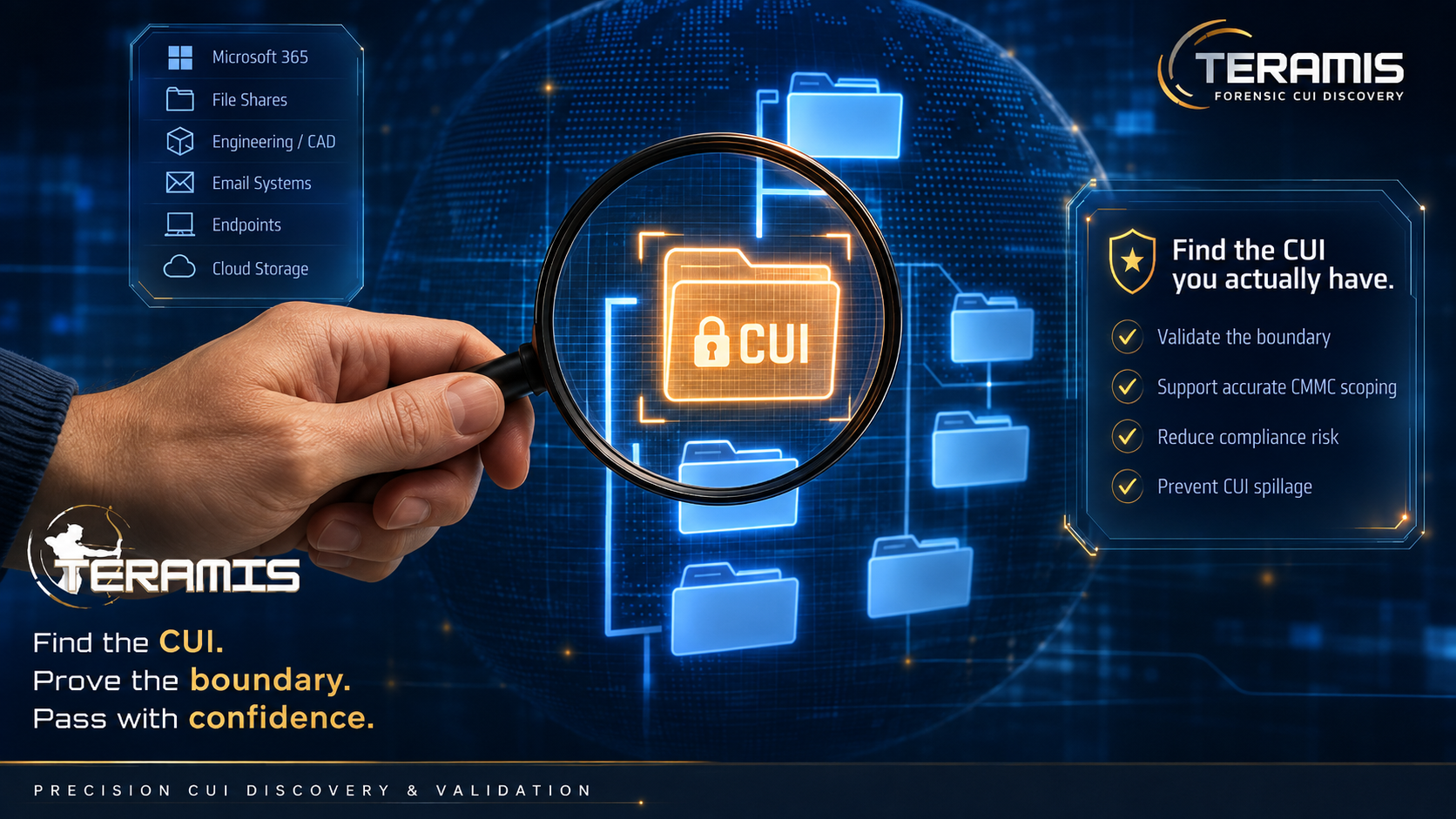
Teramis can support discovery across approved environments that include Microsoft 365, file shares, CAD files, PDFs, scans, archives, engineering repositories, email systems, endpoints, and other supported data sources.
The platform runs within the customer environment, keeping scanning and analysis under customer control. Teramis uses validation and sampling methods to support accuracy of up to 99.95 percent, while reducing the manual review burden associated with broad, generic matching approaches.
Teramis helps organizations:
Teramis does not move, tag, alter, or remediate CUI. It provides the visibility and file-level information administrators and partners need to determine what action should be taken.
CUI misclassification is not limited to a missing banner or an incorrect label.
The deeper risk is making security and compliance decisions without knowing where controlled information actually lives. That uncertainty can increase compliance costs, weaken CMMC scope, complicate incident response, and leave CUI outside the organization’s documented boundary.
The stronger approach is to begin with evidence.
Find the CUI you actually have. Validate the boundary. Monitor what changes.
Ready to replace CUI scoping assumptions with evidence? Request a Teramis demo.